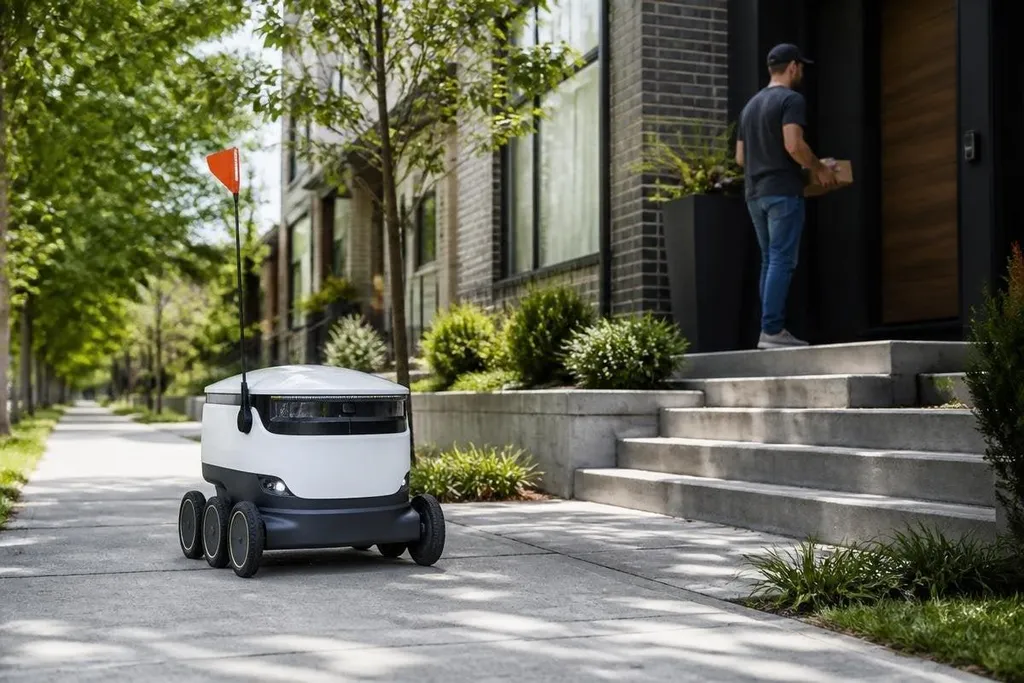
A delivery robot carries a parcel from a local hub to a customer’s door without a driver sitting inside it. Short trips can shift off roads and onto sidewalks, where speed, safety, and public access become part of the delivery job.
Quick read
- Small robots suit short routes between a local base and nearby homes.
- Cameras, LiDAR, mapping software, and remote staff share the driving work.
- The hardest problems are access, weather, loading, and public trust.
What the robot changes
A delivery van has to stop, park, and return to the road for every parcel. A sidewalk robot can leave a local store or depot, reach a nearby address, and return for another load. That makes the vehicle smaller, but it also limits the route.
Parcels sit in a locked compartment. The customer gets an access code through an app or message, then opens the compartment at the drop-off point. This keeps the parcel with the robot until the handoff instead of leaving it on a doorstep.
That setup fits food, medicine, and small retail orders. It works best when the route is short, the pavement is usable, and the customer can meet the robot at the curb or building entrance.
How the system works
Cameras and LiDAR help the robot see nearby objects. LiDAR measures distance with laser pulses, while cameras help identify signs, people, road edges, and other visual details. Mapping software helps the robot compare what it sees with the route it was given.
The robot needs rules for crossings, blocked sidewalks, driveways, and building entrances.
A remote operator can watch the route and take control when the robot reaches a case its software cannot handle. That person may supervise several robots, but the exact number depends on the system and the route.
This mixed setup matters because a delivery route has many small decisions. A parked car can block a sidewalk. A fallen branch can force a turn. A customer may move the meeting point after the robot has started its trip.
A delivery robot’s route can change after it leaves the depot, when blocked paths or a moved meeting point require human help. Robot24 puts those control decisions beside the sensors, remote operators, and public tests that shape last-mile delivery.
Where the limits show up
The robot’s small size helps it fit on a sidewalk, but that same size limits its load. A van can carry many parcels and handle long routes. A sidewalk robot usually suits a smaller group of nearby orders, with more trips when demand rises.
Buildings create another limit. A robot that stops outside a tower still needs a person to collect the parcel, unless the site has a safe handoff area or a lift system that supports the robot. Stairs, narrow doors, snow, standing water, and damaged pavement can stop the route.
Weather also affects the work. Rain can reduce camera performance, while ice changes traction and braking. A fleet operator needs a plan for charging, cleaning sensors, checking locks, and removing robots from service when conditions are unsafe.
Public space adds a second test. People need to pass the robot without stepping into traffic, and the robot must stop when its path is blocked. Local rules may also control where it can travel, how fast it may move, and who answers for a collision.
What changes for delivery work
Delivery robots can shift some driving and walking tasks to a local machine. A worker may load the robot, monitor routes, fix faults, or complete the final handoff when a building needs human access. The job changes with the system rather than disappearing from every route.
The cost question depends on the full operation. A company must count the robot, software, remote supervision, charging, repairs, insurance, and staff time. A robot that needs frequent rescue calls may add work instead of cutting it.
I'd use delivery robots first on short routes with repeatable stops, clear sidewalks, and a staffed local base. That gives the operator a small area to measure before adding harder roads or larger service zones.
A practical deployment check
Before putting a delivery robot on a route, check these points:
- Map the route: record crossings, slopes, narrow sections, curb cuts, and places where people queue.
- Set the load limit: match parcel size, weight, temperature needs, and locker space to the robot’s actual compartment.
- Plan human help: name the person who handles blocked paths, locked doors, failed handoffs, and roadside recovery.
- Test the handoff: confirm that customers can open the compartment and reach the meeting point without entering traffic.
- Track failures: log stops caused by weather, people, access, battery charge, and sensor dirt.
Those records show where the robot saves a trip and where it creates one. They also give the operator a basis for deciding if the route should grow, stay small, or return to a van.
The next step for delivery robots is not a citywide rollout by default. It is better route data, clearer sidewalk rules, and enough successful handoffs to show where a small machine beats a vehicle.